
Diana Der-Hovanessian Prize, selected by Kymm Coveney
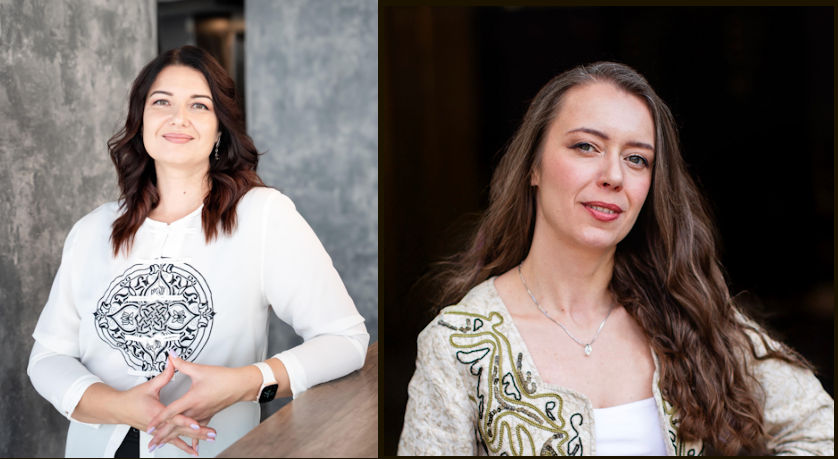
(Photograph, L to R: Mariya Tytarenko, Yuliya Musakovska)
Mariya Tytarenko is a writer, poet, and media researcher. She is an Associate Professor at the School of Journalism and Communications of the Ukrainian Catholic University and a member of PEN Ukraine. She published two essay collections, Communication from Zero: Essays for Mania and Not Muses, but Muscles: 50 Exercises in Creative Writing, as well as the children’s book Aki-yaki-aka-ya.
She holds a Ph.D. in Social Communications and was a Fulbright Faculty Development Program Fellow (2008-2009). Her awards include the Bohdan-Ihor Antonych Literary Prize (2010), the Catholic Press Award (2012), and the KBU Award for the best non-fiction (2025). Her poetry has appeared in Ukrainian magazines, her translated work in International Poetry Review: Selected Poetry, and Trafika Europe.
Yuliya Musakovska is a Ukrainian poet and translator, author of six poetry collections, most recently Stones and Nails (2024). Her book The God of Freedom was published in the U.S. by Arrowsmith Press in English translation by Olena Jennings and the author. Her poems have been translated into more than thirty languages and featured in journals including AGNI, Tupelo Quarterly, The Southern Review, and The Common. She translates from English and Swedish, including Tomas Tranströmer, and published her translation of soldier-poet Artur Dron’s We Were Here into English with Jantar Publishing. A member of PEN Ukraine, she now focuses on cultural advocacy for Ukraine.
The Parable of the Hands
By Mariya Tytarenko

Take yourself in hand, woman.
Take yourself in hand.

She found hands on the roadside
and brought them home.
Put them in her lap
and breathed life into them.
The hands started branching out—
first, with forearms and shoulders,
then joined by a ribcage;
a heart stirred underneath—
and a man revealed himself.

She nursed him back to life,
taught him to speak, crawl, and walk,
ride a horse, and bear arms.

Until one day,
he went off to war.

Hold your hands steady, woman.
Hold your hands steady.

Grandfather went to war—and never came back.
Father went to war—and never came back.
Husband went to war—and never came back.
Brother went to war—and never came back.
The eldest son went to war—and never came back.
The middle son went to war—and never came back.
The youngest son went to war—and never came back.

Don’t drop your hands, woman.
Don’t drop your hands.

Hands go to war and never come back.
Arms go, legs, heads, backs, and chins go to war.
There are not enough hands for all,
not enough arms, legs and feet for all,
heads, backs or chins.

The woman gives them her farewell blessing,
as she gave her grandfather,
as she gave her father,
as she gave her husband,
as she gave her brother,
as she gave all three of her sons.

Then she pulls herself firmly from her hands—
and falls apart.

(Translated from Ukrainian, original below)


Марія Титаренко

притча про руки

візьми себе в руки жінко
візьми себе в руки

знайшла руки при дорозі
узяла додому
поклала на коліна
вдихнула життя
руки почали відростати
спочатку передпліччями і плечима
тоді з‘єднались грудною кліткою
в якій стрепенулось серце
і стався чоловік

виходила його вигодувала
навчила говорити повзати ходити
їздити на коні тримати зброю

аж одного дня
зібрався на війну

тримай себе у руках жінко
тримай себе у руках

дід пішов на війну і не вернувся
батько пішов на війну і не вернувся
чоловік пішов на війну і не вернувся
брат пішов на війну і не вернувся
старший син пішов на війну і не вернувся
середній син пішов на війну і не вернувся
молодший син пішов на війну і не вернувся

не опускай рук жінко
не опускай рук

руки ідуть на війну і не вертаються
ноги ідуть голови спини підборіддя

рук на всіх не вистачить
ніг на всіх не вистачить
голів спин підборідь

жінка благословляє на прощання
як діда як батька як чоловіка як брата
як усіх своїх трьох синів

а тоді бере себе міцно з рук
і випускає