
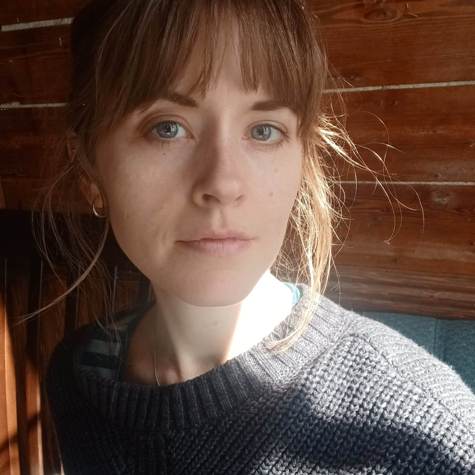
Jean Pedrick Chapbook Prize Finalist, selected by Matthew E. Henry
Devan Murphy is the author of the chapbook I’m Not I’m Not I’m Not a Baby (Ethel 2024), a collection of prose poems and essays and abstract comics about God and loneliness. Her writing and illustrations have appeared or are forthcoming in Electric Literature, Gigantic Sequins, The Cincinnati Review, -ette, The Iowa Review, The Guardian, Moon City Review, and elsewhere. You can find her online at devmurphy.club or on Instagram @gytrashh. She lives in Pittsburgh.
Three Poems from I’m Not I’m Not I’m Not a Baby
On Working in an Art Gallery, or On Working in an Intimate Space

In the art gallery, the door opens inward, but when they leave, visitors try to push instead of pull. I suspect there is something about small spaces—or art, maybe—that makes a person feel they are bursting forth when they leave, being born. They try to push, and then they look at me at my desk, they are embarrassed, and then they pull. // The difference between pushing and pulling—or more interestingly, or just as interestingly, the difference between being sure you can push out, and finding you must instead pull in. . . . People leave the gallery with a strange confidence sometimes. Jules Michelet wrote that a bird uses its whole body to build its nest. “The instrument that prescribes a circular form for the nest is nothing else but the body of the bird. It is by constantly turning round and round and pressing back the walls on every side, that it succeeds in forming this circle.” // I like to believe visitors to the gallery are empowered by the minutes spent walking about the room, nesting. But the nest energy, the building-out, is interrupted by the jolt of a door that won’t obey, and by the realization that they cannot reenter real life by bursting forth, but by making themselves smaller for a moment.

The Hoard

My therapist says Most artists are neurotic and I say I don’t want to be neurotic and he says The other end of the spectrum is a rock. Would you rather be a rock? // You call me a flying squirrel. I say you are a lion, a bull. // Barthes wrote I am the lover, I am the one who waits but what good does this do for the beloved? The beloved, who must mow the lawn and paint a picture of a cow and who wants you to get on with your life. // Lewis wrote Be a circle, touch me again but what good does this do for the sphere, who is a sphere? // I have not painted in weeks. I bring my shivering hands to the blank canvas, prop it up and then withdraw, prop it up and then withdraw. // Solomon wrote Do not arouse or awaken love until it so desires. And when it does not desire, I stand watch over it. I put an afghan over it while it sleeps to keep it warm. I do not leave the room. // You call me to a world in which not waiting is a form of waiting. To be the rock and the circle at the same time—this is what it means to be a sphere. // Lewis also wrote Do not love anything, not even an animal, and your heart will never be broken. // I would rather be a rock: irredeemable, casketed, and waiting on no one. But I am desirous all the time of you, all the time desirous to the point of waiting all day for you, while you are painting and mowing and making your dinner. My basil is wilting and my inbox is full, and when you come to me with seeds and soup and paper and invitations, I am a soundless edge—you are here!—and in your presence still I wait, wait, with nothing to show for myself but my love, with nothing to show for my love but my loving. Prop it up and then withdraw. // I do not know if you are in love with me, but if you are, you are in love with a dead squirrel. // Straight-faced and with tender paws I lay your gifts in a shoebox under my bed. There they calcify, they colden.

Lamb’s Ear

I think about what I would leave my children if I had any: lessons in self-comfort, habits to help them breathe, a prayer, a walk, picking up lamb’s ear by the side of the road. After a heavy rain the stalks bow down but when they dry they stand up again. I carry an ear in my fingers and stroke it as I walk. // Once as a child I heard the Lord say to me My frightened little lamb. Most of my beliefs have left me but I hold onto that. But how can you explain to a therapist who wants to know if you’ve ever heard the voice of someone who is not there that yes you have but this is different? When the therapist says, “So it was the result of sleep deprivation, desperation, sadness, loneliness,” I say, “I guess,” but what I’m really thinking is, How do you expect to help me if you don’t believe what I’m telling you? If we’re talking about life and death here, you should know that I don’t want to live in a world where I don’t now and then hear the voice of God.