
Jean Pedrick Chapbook Prize Finalist, selected by Matthew E. Henry
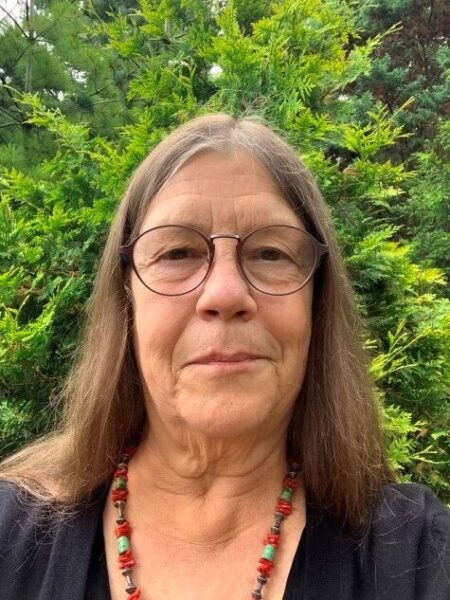
Tricia Knoll is an aging Vermont poet who lives in the woods with two dogs. Nine of her collections are in print, both full-length and chapbook. Her 2018 book How I Learned to Be White received the Human Relations Indie Award for Motivational Poetry. Like The Unknown Daughter, Wild Apples (Fernwood Press) was published in 2024 and highlights poems of downsizing and moving 3,000 miles from Oregon to Vermont in 2018. Many her poems, published in dozens of journals as diverse as Kenyon Review and New Verse News, have been nominated for Pushcart or Best of Net prizes. Knoll is a Contributing Editor to the online poetry journal Verse Virtual. triciaknoll.com
Poems from The Unknown Daughter (Finishing Line Press, 2024)
Tomb of the Unknown Daughter

Many wonder about her body,
possibly embalmed or clumped ash
inside white marble. Most hesitate
to ask. Sometimes the eternal flame
falters. The Watchwoman may wait
a bit before she tends it. Reverence
is not ritualized or punctual –

and so many visitors, even those
in high heels or cowgirl boots,
know that multitudes still
quietly perform false tricks
for acceptance withheld.

A pamphlet mentions the miscarried,
the stillborn. Abortions
and those given up for adoption.
Those taken and never seen again.
The penultimate line asks
if your mother remains
undiscovered. The last line
is a phone number for 24-hour help.

Adjacent, on the plaza,
find movable chess queens
and babies on wheels sculpted
of pietra gray marble, interactive
sundials for hands-on
shadow casting and some joy
in slow motion.
The gnomons.

Some tour buses don’t stop.
Vehicles that linger provide a brief
respite for stretching and relief
from the tour guide’s drone
that includes this caution for the Tomb –
Silence is never necessary.
Respect speaks.
Many Unknowns

Simple references often follow
the word his – influencer, inspiration,
amanuensis, sister, wife, mother,
or daughter.

Unacknowledged
in undiscovered symphonies,
unhung paintings, even the lament
involving Wulf and Eadwacer
with no poet’s name.

Or lost in time, ones who
sold sweet potato pies to
raise money for civil rights actions,
baked pot brownies for AIDS patients,
fought arranged marriages, assisted
Tutsis fleeing death in Rwanda, spied
dressed in men’s clothing to confuse
armies, ruled as queens in Nubia,
hefted swords as pirates, organized
farm workers, warned of climate change
in 1856, sneaked onto the road to run
a marathon, discovered a way to treat malaria,
invented coffee filters, studies volcanos.
Became firsts. Those who called themselves
Wild Girls and marched as sisters, rode
on white horses and wore star quilts.
Became firsts wearing names
like Ada Lovelace and Tu YouYou.
Snow Angel

Silence after a record snowfall.

The tomb, the chess queens, and the babies
wear rounded ten-inch cloches of white.
No Watchwomen
this paid snow-day.

Buses fitted with chains
take an alternate route.
Forecasters imply a melt
and blame climate change.

A squirrel hops about
in dashes of transit.

A woman who lives uphill,
an illustrator of children’s books
who has no children of her own,
tugs on her tallest boots,
a red wool hat, and bright blue mittens.

Fluffy in her gray down coat,
she trudges to the courtyard
of the gnomons,
rests on her back,
and scissors
her arms and legs.