
Dear Friends,
I’ve no big alerts for my letter this month, though after our upcoming Board meeting on June 6th, I expect I’ll be able to announce a few interesting items in the next issue: several new Board and Advisory members; updates about the second summer of WE (too) THE PEOPLE at the Longfellow House; a new poetry initiative that will help us attract younger poets to the NEPC ranks; and a possible new poetry page for our website (more details soon!). We are still looking for a few volunteers to help out with WE (too) and the Golden Rose event (you can e-mail me at: president@nepoetryclub.org to join us)
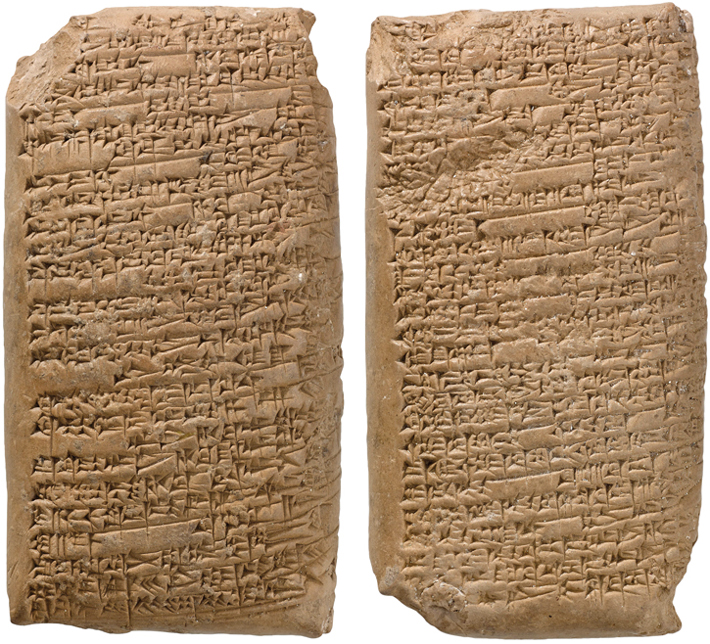
The front and back of a cuneiform tablet bearing a poem by Enheduanna. Photo credit: Pintrest.com
But, instead of news, I thought I’d offer a few thoughts about something quite old–– a presence that has been making regular appearances in my thinking for three decades now: Enheduanna. Likely, many of you know of her, but for those who do not, I’ll offer a thumbnail sketch. She has the distinction of being the first author, in all of recorded history, for whom we have a name attached to their work. Sumerian poet, princess, mathematician, and moon-priestess, Enheduanna lived four millennia ago (1700 years before Sappho in Greece and 2000 years before Qu Yuan in China). Five of her long poems survive on clay tablets in full or partial form–- but, together, the size of the material is far greater than her better-known Greek counterpart, and rivals that of the Chinese poet immortalized in the Chu Ci. Hasn’t this happened to you: some new name, poem, historical event you’d never heard of before, comes to your attention–and then, as time passes, the references begin to multiply, almost as if the universe was trying to offer you some esoteric instruction.
I was first introduced to Enheduanna in Jane Hirshfield’s marvelous anthology, Women in Praise of the Sacred: 43 Centuries of Spiritual Poetry by Women, published back in 1994. My imagination was charged as I tried to picture her life and the world she inhabited. It’s astonishing to realize the power she’d achieved–- and magnified when you consider she lived during an age that was even less hospitable to strong women than our own. After that introduction, and every now and again, her name would pop up in my reading-– poems in which she was a character; mentions of her life in the ancient city-state of Ur. Just this week, the priestess’ name was a clue in a New York Times puzzle. Over the years, I feel I’ve intuited a variety of lessons from this ancient poet. But here’s what’s struck me this week:
At a time when our very culture feels under siege––and our very survival seems an open question––Enheduanna fortuitously makes another appearance. I can’t help wondering: did she imagine humans would be speaking her name, reading her holy verse, forty centuries beyond her time on Earth? I very much doubt it. Certainly, you or I would have to be more than a little delusional to think our poetry might endure as long. (I’m happy when I’m remembered from one week to the next.) Still, we read, write, investigate the world in which we make our home. But isn’t that oh-so-human quality––our desire to imagine, to comprehend––part of the very bedrock of all literature and art? So this is the crucial question: Am I being naïve to imagine poetry’s ancient tradition enduring for millennia beyond this one? To conceive of this work we do, you and I, as being a part of that unscrolling narrative feels somehow reassuring. Whether it’s an important part or infinitesimally small is beyond our knowing and, perhaps, better left for others to consider. But even in a week with more dark headlines, the continuity of this ancient tradition seems a sufficient reason to go back to work––to try to make something new, which might help our fellow citizens take their bearings, feel at peace. That seems to me a worthwhile undertaking. Thank you, Enheduanna. And thank you all.
With my warm regards,
Steven
– President, NEPC